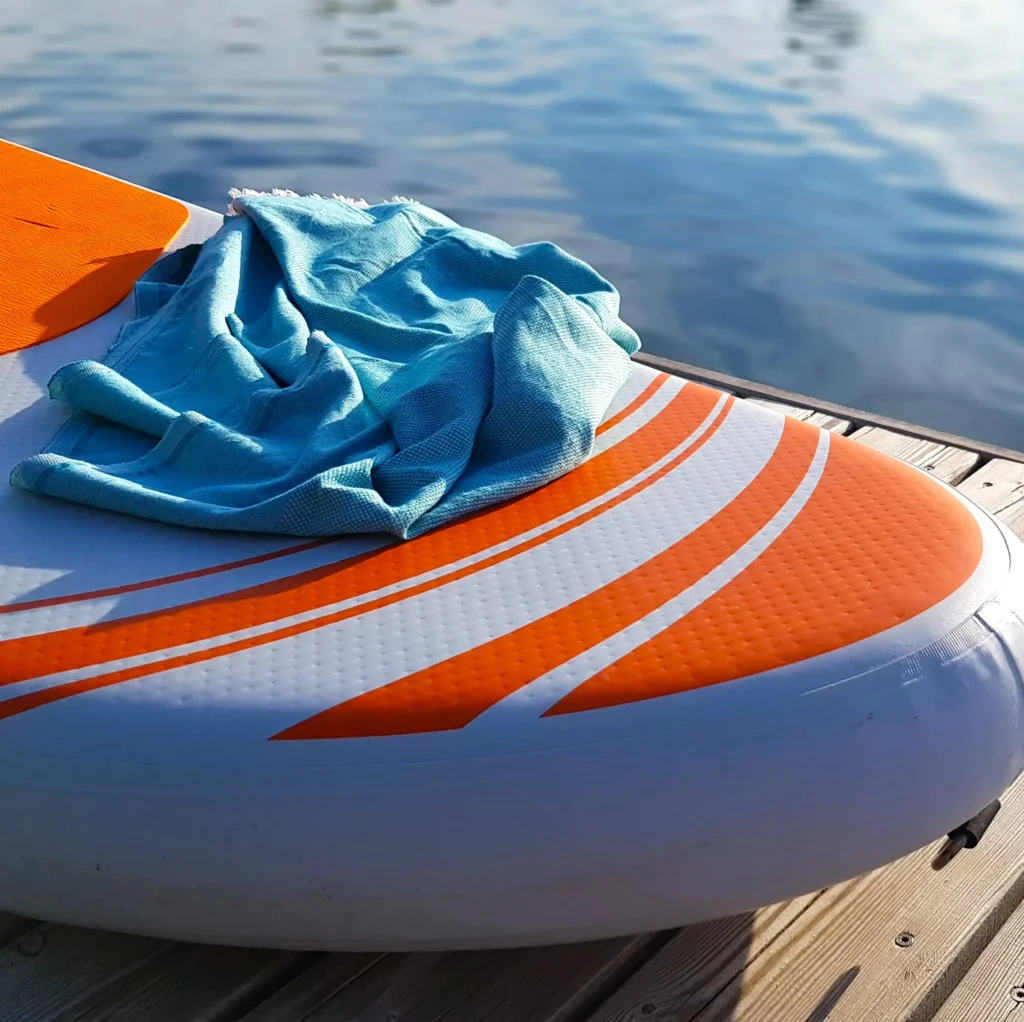

The first few moments on a stand up paddle board are unforgettable. You step onto the water, feel a slight wobble beneath your feet, and then, almost unexpectedly, everything settles. The board glides forward, the shoreline grows quieter, and for a while the only sounds are your paddle dipping into the water and the occasional call of a bird overhead.
Stand up paddle boarding, often called SUP, has become one of the fastest-growing water sports in recent years, and for good reason. It is easy to learn, suitable for almost every age group, and can be as relaxing or as challenging as you want it to be. Whether you are paddling across a calm lake at sunrise or exploring a hidden cove by the sea, SUP combines exercise, adventure, and time outdoors in a way few sports can.
For beginners, stand up paddle boarding offers a gentle introduction to water sports. For experienced paddlers, it opens the door to longer tours, fitness training, and even SUP yoga. Whatever your level, every session starts with the same essentials: the right equipment and a willingness to step onto the water.
Why Stand Up Paddle Boarding Is Worth Trying
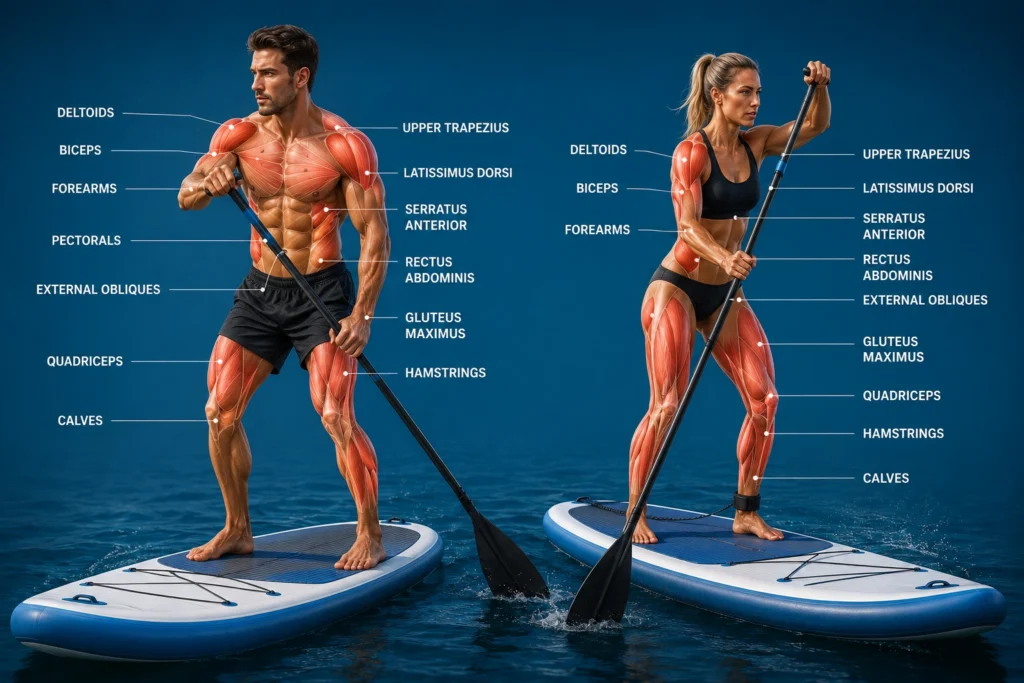
Unlike many sports that focus on a single muscle group, paddle boarding engages the entire body. Maintaining balance activates your core muscles almost continuously. Every paddle stroke involves your shoulders, arms, chest, and back, while your legs work quietly in the background to stabilize your stance.
Regular paddle boarding can help improve:
- Balance and coordination
- Core strength
- Shoulder and upper body endurance
- Leg stability
- Cardiovascular fitness
- Posture and flexibility
Many physiotherapists and fitness coaches recommend activities that strengthen the core because a strong midsection supports the spine and helps prevent back pain. SUP achieves this naturally. You are constantly making small adjustments without even noticing it.
There is also a mental benefit. Spending time on the water has a calming effect that many paddlers compare to meditation. After an hour on a paddle board, it is common to feel physically energized and mentally refreshed. In a world filled with notifications and schedules, standing in the middle of a lake can feel surprisingly luxurious.
Equipment Needed for Stand Up Paddle Boarding
One of the biggest advantages of inflatable paddle boards is portability. Everything fits into a compact backpack, making it easy to transport in a car, camper van, or even on public transport.
Before heading to the water, make sure you have the following equipment:
- Inflatable paddle board
- Adjustable paddle
- Safety leash
- Hand or electric pump
- Fin
- Carry backpack
- Personal flotation device (recommended)
- Compact cotton towel
- Drinking water and sunscreen
Most inflatable SUP sets include the main components, making them ideal for beginners. The beauty of inflatable boards is that they take up very little space when packed. What looks like a large piece of sports equipment on the water often starts as a neatly folded package in a backpack.

Unpacking Your Paddle Board
Arriving at the water is part of the experience. Many paddlers describe it as a small ritual.
Start by placing the backpack on flat ground and removing the contents one by one. Lay out the paddle board and unroll it completely with the valve facing upward. You will notice how compact everything seemed just moments before.
Next, take out the pump, paddle, fin, and leash. Most boards include clearly marked attachment points, making assembly straightforward even for first-time users.
At this stage, your equipment checklist should look like this:
- Paddle board unrolled
- Pump connected
- Fin ready for installation
- Leash unpacked
- Paddle assembled
This process typically takes less than ten minutes once you become familiar with your gear.
Pumping Air Into the Board
Inflatable paddle boards are remarkably durable once inflated. Modern boards are designed with dense drop-stitch construction, allowing them to become rigid and stable on the water.
Attach the pump hose securely to the valve and begin pumping. During the first few minutes, the board fills quickly and starts taking shape. The final stage requires a bit more effort as the internal pressure increases.
Most manufacturers recommend inflating the board to between 12 and 15 PSI, although some premium models support higher pressure levels. Check your board’s specifications before use.
Think of it as your warm-up before the actual activity. By the time the board reaches the recommended pressure, your shoulders are awake and your body is ready to move.
Once inflated:
- Disconnect the pump.
- Close the valve cap securely.
- Install the fin underneath the board.
- Attach the leash to the designated D-ring.
- Adjust your paddle to approximately wrist height.
Your paddle board is now ready for the water.
Your First Minutes on the Water
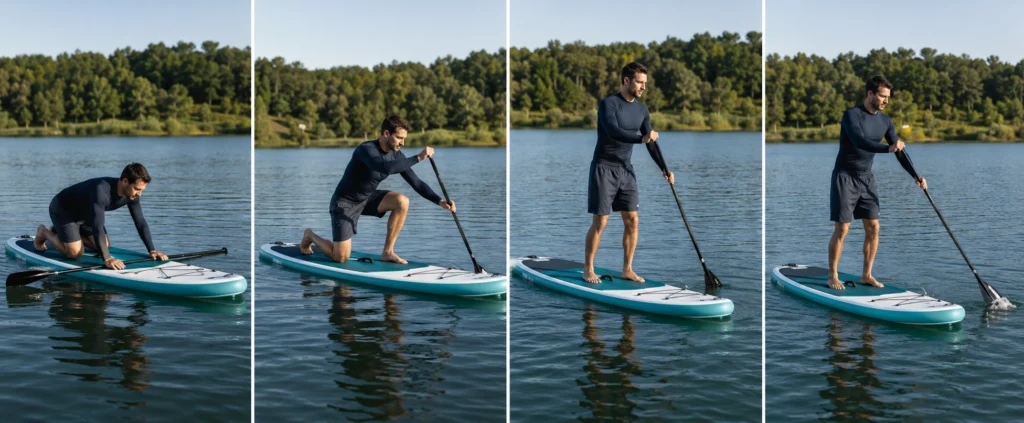
Beginners often make the same mistake: they stand up too quickly.
Instead, start on your knees in calm, shallow water. Take a few paddle strokes and allow yourself to get comfortable with the board’s movement. When you feel stable, place one foot at a time where the carry handle is located, then slowly stand up.
Keep your knees slightly bent and your eyes focused on the horizon rather than looking down at your feet. The body naturally follows where the eyes are directed.
Remember these beginner tips:
- Paddle on calm water whenever possible.
- Keep your feet shoulder-width apart.
- Switch paddle sides regularly.
- Avoid stiffening your legs.
- Accept that falling into the water is part of learning.
Even experienced paddlers occasionally lose their balance. The difference is that they usually laugh before climbing back onto the board.
Benefits for Body and Mind
Stand up paddle boarding is often described as a full-body workout disguised as a leisure activity.
An hour of paddling can burn a significant number of calories while placing minimal stress on the joints. Unlike running, which repeatedly impacts the knees and ankles, SUP offers low-impact movement suitable for many fitness levels.
The body parts that benefit most include:
- Core and abdominal muscles
- Lower back
- Shoulders
- Arms and forearms
- Glutes
- Quadriceps and calves
Beyond the physical benefits, paddle boarding encourages mindfulness. You become more aware of the weather, the movement of the water, and your own breathing.
Many people discover that paddle boarding becomes less about fitness and more about creating space in their day. A quiet morning paddle before work can be surprisingly effective at resetting the mind.
Packing Everything Away
Eventually, every paddle session comes to an end.
After leaving the water, rinse your board with fresh water if possible, especially after paddling in the sea. Allow it to dry briefly before opening the valve.
Air escapes quickly once the valve is released. Starting from the nose of the board, roll it tightly toward the valve to remove the remaining air. Fold the board neatly and place it back into the carry backpack.
Then pack the remaining equipment:
- Remove and store the fin.
- Disconnect and pack the pump.
- Roll up the leash.
- Separate the paddle sections.
- Store all accessories together.
A complete pack-down usually takes less than ten minutes, leaving you with a surprisingly compact bag ready for your next adventure.
Why a Compact Towel Belongs in Every SUP Bag
There is one piece of equipment that often gets overlooked until it is needed: a towel.
After a swim, an unexpected splash, or simply packing up at the end of a session, having a lightweight towel nearby makes a noticeable difference. Whether you are paddle boarding at the beach, spending the day by a lake, travelling in a camper van, or relaxing in a sauna after your session, a compact towel quickly becomes an essential part of your gear.
Traditional towels can take up valuable space in your backpack and stay damp for hours. A lightweight cotton towel is easier to pack, dries faster, and leaves more room for the equipment you actually need.
A compact cotton towel is an ideal companion for stand up paddle boarding. It fits easily into your SUP bag, travel bag, beach bag, or backpack and is ready whenever you need it. Many paddlers also use the same towel for beach trips, travel, camping, swimming, wellness visits, and sauna sessions, making it one of the most versatile items to carry outdoors.
The best paddle boarding gear is equipment that helps you stay focused on the experience itself. A board gets you onto the water. A paddle keeps you moving. A leash keeps you connected to your board. And a lightweight, compact cotton towel helps you stay comfortable before, during, and after every adventure.